
The best decision, under your real conditions.
Circonomit calculates which decision, within your real constraints — capacity, budget, commitments — produces the best trade-off. Not as intuition. As a calculated result.

Theoretical optima do not hold up under real conditions.

Optimization without real constraints is theory. Your decisions have to hold up under capacity limits, budget caps, delivery commitments — that is where most optimization breaks down.

Intuition-based decisions have no explicit price. What every alternative costs, what you give up by the choice — that stays a feeling without a calculated model.

Point solutions solve one problem. Which decision, across your real trade-offs, produces the best result — that needs a model of the whole problem, not a sub-optimization.
Circonomit calculates the achievable optimum.
Your systems manage what is. Circonomit calculates what is best — within your real constraints. Capacity, budget, delivery commitments — every boundary is an explicit model parameter, not a free assumption.
Model
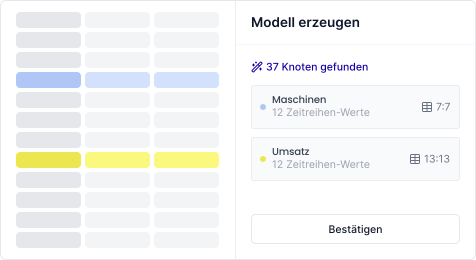
First the optimization problem is structured: what is the goal? Which constraints are binding? Which trade-offs are decision-relevant? Circonomit connects your data and domain knowledge into a calculable model.
Simulate
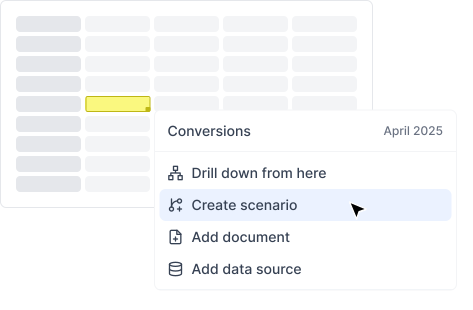
Before optimization, Circonomit simulates the relevant scenarios — so you see how robust the optimum is across the parameter range, not just at one point.
Optimize

Circonomit calculates the decision that produces the best trade-off under your real conditions. Not the theoretical maximum, the achievable one. With an explicit price for every alternative.
The achievable optimum. Not the theoretical one.
The result: a calculated model for your optimization problem, with three to five quantified alternatives and an explicit cost-benefit comparison. You know which decision holds up under real conditions, and what every deviation concretely costs.
From intuition to calculated optimum.

You see which decision produces the best trade-off under your real conditions — calculated, not estimated.
Every alternative carries a price. Circonomit makes it visible before you decide.
No new data project. Circonomit works with your existing data.
What you want to know.
Q:
How is this different from classical optimization tools?
A:
Classical optimization tools assume a clean model and clean data. Circonomit is built for the reality of mid-sized manufacturers: incomplete data, expert knowledge in planners’ heads, constraints that only become clear during modelling. The modelling approach is explicit — not a pre-built solver, a structured process that delivers a defensible model.
Q:
What does the pilot concretely deliver after 3 weeks?
A:
A calculated model for the agreed optimization problem, based on your real data. Three to five quantified alternatives with an explicit cost-benefit comparison. A comparison against current practice. The success criterion is agreed in writing before work starts. Fixed price: EUR 7,500 net.
Q:
Does Circonomit replace our ERP or APS?
A:
No. ERP manages what is planned. APS optimizes capacity. Circonomit calculates the decision trade-offs those systems are not built for. Circonomit complements your existing systems — it sits on top of them, not instead of them.


Circonomit testen
Sprechen Sie in Ruhe mit dem Team.
Erstgespräch bei einem digitalen Kaffee
Wir verstehen Ihr Problem
Pilotmodell in 3 Wochen, Fixpreis 7.500 €
Auf Basis Ihrer realen Daten. Erfolgskriterium schriftlich vereinbart
Entscheidungen, die Sie vertreten können
Nachvollziehbar, quantifiziert, wiederholbar


