Where are the bottlenecks, and what do they cost us every day?
Circonomit calculates where between supplier, production and shipping the critical bottlenecks sit, and what each of them costs every day. Concrete, not estimated.

Every bottleneck has a daily price.

Planning runs into its limits every day. Where exactly the bottleneck sits — between supplier, machine or shipping — and what it costs, stays unclear.

A bottleneck wanders: you solve it in one place, it reappears in the next. Without a full model of the supply chain, every measure is an experiment.

What a bottleneck costs every day — in lost orders, delay costs, overtime — is reported nowhere. The price exists. It just is not booked.
Circonomit makes every bottleneck visible, and calculable.
Your ERP shows where bottlenecks occur. Circonomit shows which bottleneck has the highest daily price and how to resolve it most efficiently. Concretely calculated before you act.
Model
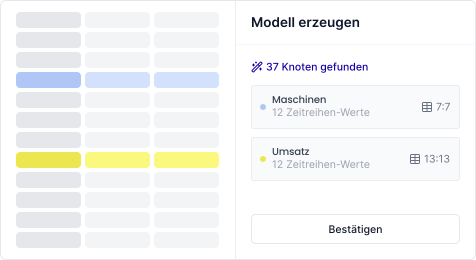
First the supply chain is structured as a decision problem: where are the capacity limits? Which dependencies exist between supplier, production and shipping? Which buffers exist, and which are missing? Circonomit connects your data into a calculable model of the full chain.
Simulate
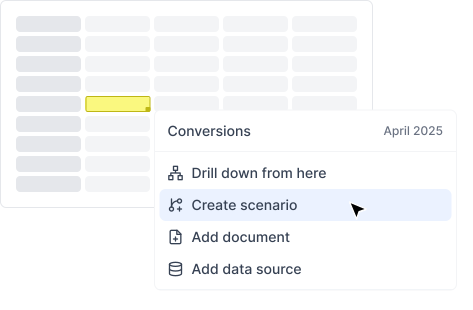
What happens if a supplier is out for two weeks? What does a machine failure at position three of the chain cost? Circonomit simulates the consequence of every bottleneck scenario before it happens, not after.
Optimize
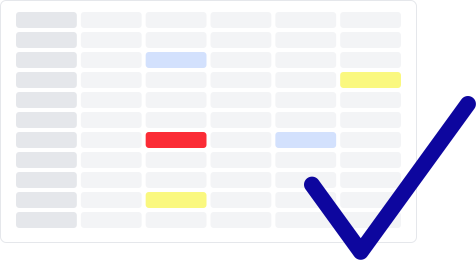
Circonomit calculates which measure resolves the critical bottleneck with the highest daily price most efficiently, within your real budget limits. With an explicit cost-benefit comparison for every alternative. A recommendation you can defend internally.
The bottleneck has a name. And a price.
The result: a calculated model for your supply-chain bottleneck, with three to five quantified measure scenarios and a clear cost-benefit comparison. You know which measure has the greatest effect under your real conditions, and what doing nothing concretely costs.
See, evaluate and resolve bottlenecks deliberately.

You see where the critical bottleneck sits, and what it costs every day. Calculated, not estimated.
Circonomit evaluates every measure before you implement it: what does it deliver, and is that enough to resolve the bottleneck economically?
No new data project. Circonomit works with your existing data from ERP, supplier management or Excel.
What you want to know.
Q:
How is this different from our ERP or supply-chain tool?
A:
Your ERP and your supply-chain tools show what is planned and what happened. Circonomit answers a different question: which bottleneck in your chain has the highest daily price, and which measure resolves it most efficiently? That is not a monitoring function, it is a decision function. Circonomit complements your existing systems, it does not replace them.
Q:
What does the pilot concretely deliver after 3 weeks?
A:
A calculated model for a clearly scoped bottleneck in your supply chain, based on your real data. Three to five quantified measure scenarios with an explicit cost-benefit comparison. A comparison against current practice. The success criterion is agreed in writing before work starts. Fixed price: EUR 7,500 net.
Q:
Does Circonomit work even when our supply-chain data is incomplete?
A:
Yes. Incomplete data is the rule in supply chains, not the exception. Circonomit works with what you have and makes transparent which data gaps affect decision quality and how. Missing data we replace in the first step with structured expert knowledge from your planners and dispatchers.


Try Circonomit
Talk to the team. No pressure.
Initial consultation over a virtual coffee
We understand your challenge
Pilot model in 3 weeks, fixed price €7,500
Based on your real data. Success criterion agreed in writing.
Decisions you can stand behind
Traceable, quantified, repeatable